Why a Wooden Gate is the Ultimate Asset for Comfort and Security in Belgium
Introduction
Designing a property’s entrance is often viewed as a simple property line marker or an aesthetic formality.
However, with increasing urban density, the boundary between public space and the private sphere requires solutions that go far beyond a basic visual barrier. A home's perimeter must now actively filter a complex external environment.
In this context, the architectural approach to the threshold is evolving. Material choices are no longer just about design, but about home engineering. Solid structures are making a justified comeback due to their specific physical properties, which are highly effective at mitigating urban and suburban nuisances.
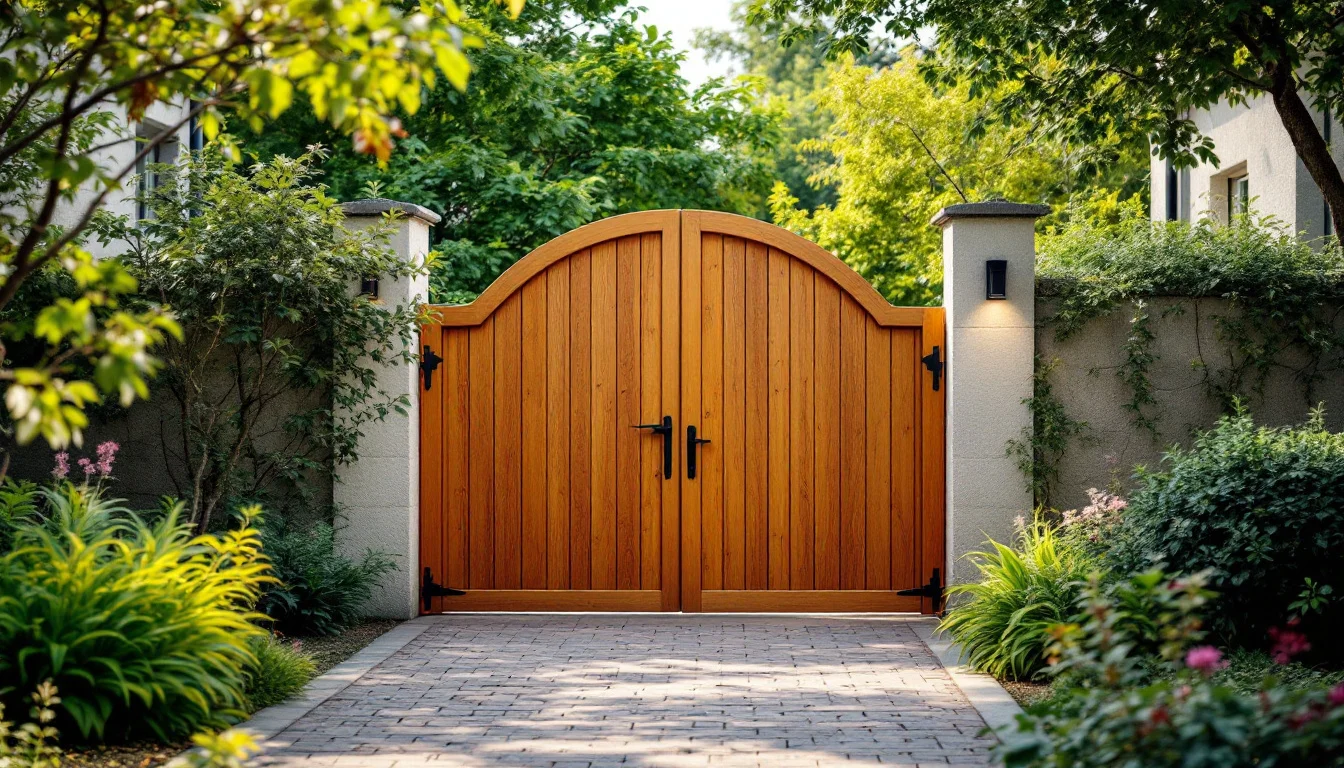
The solid gate thus emerges as a multifunctional line of defense. Beyond simply providing access, it acts as a climate and security bulwark. Understanding its cellular mechanics and physical inertia helps optimize indoor comfort before you even cross the threshold.
Key Takeaways
- Natural acoustic insulation: Wood's cellular structure dissipates sound waves, acting as a barrier against traffic, engine, and road noise.
- Essential climate stability: Belgium's successive cycles of freezing, thawing, and rain strictly require Class I or II durability wood to maintain dimensional integrity.
- Physical deterrence: The significant mass and total opacity of a solid wood model provide mechanical resistance superior to PVC, while preventing potential intruders from scoping out the property.
Why Does Suburban Density Require the Physics of Wood?
How does wood's cellular structure mitigate noise?
Installing a separation barrier helps address noise pollution. Wood's natural cellular structure makes it a highly effective acoustic insulator, acting as a sound shield against traffic noise (engines, tire rumble).
Unlike metals that reverberate sound waves, wood's microscopic network traps air and absorbs acoustic energy. This physical dissipation reduces the transmission of decibels from the street to your outdoor living spaces, transforming an exposed courtyard into a quiet buffer zone.
What are the thermal stability advantages of wood?
Beyond its acoustic performance, this material reacts uniquely to solar radiation and temperature fluctuations. Wood provides tactile comfort and thermal stability, unlike aluminum, which can become scorching hot in the summer and freezing cold in the winter.
This low thermal conductivity offers a direct ergonomic advantage in daily life. It limits the risk of discomfort or superficial burns when manually operating the gate. For families with pets or young children playing near the entrance, this surface inertia is a significant practical benefit.
Why Are Durability Classes I and II Suited for Freeze-Thaw Cycles?
How does wood react to Belgian weather conditions?
The temperate oceanic climate puts exterior woodwork under constant mechanical stress. Belgium's alternating cycles of freezing, thawing, and rain demand Class I or II durability wood to guarantee dimensional stability.
Moisture seeping into unsuitable materials freezes, expands, and causes micro-fractures that weaken the overall structure. For a wooden gate to remain functional without warping, selecting a high-density wood species is a technical necessity. Woods classified as Class I (very durable) or Class II (durable) feature a tight grain that naturally limits capillary water absorption, thus preventing deformation during sudden temperature drops.
What is the role of protective oils and resins?
The resilience of these premium categories does not rely solely on added treatments, but on their biological composition. These species secrete natural oils and resins that saturate the wood fibers, blocking the growth of wood-decay fungi and warding off wood-boring insects.
How does the climate impact the opening mechanics?
Maintaining dimensional integrity over the long term is vital for the kinematics of the opening system. A gate leaf that shifts or sags even a few millimeters due to the weather will inevitably lead to misaligned hinges, premature wear on the pivot axes, and malfunctioning lock mechanisms.
How Do Wood, Aluminum, and PVC Compare in the Belgian Climate?
Choosing a gate requires an objective comparison of how different materials react to environmental and security constraints. It is important to note that durable wood species often entail a higher initial budget and specific supply or maintenance requirements, which must be weighed against their superior physical characteristics.
| Physical Criterion | Solid Wood (Class I/II) | Aluminum | PVC |
|---|---|---|---|
| Acoustic Insulation | High (Cellular absorption) | Low (Reverberation) | Low (Hollow core) |
| Thermal Stability | Excellent (Natural inertia) | Poor (Thermal conductor) | Average (UV sensitive) |
| Frost/Warping Resistance | High (If tight grain) | High (Insensitive to frost) | Low (Becomes brittle in the cold) |
| Mass-Based Deterrence | Significant (Density and weight) | Average (Perceived lightness) | Zero (Mechanical flexing) |
An analysis of these characteristics reveals wood's specific advantages when it comes to environmental regulation. While aluminum boasts excellent structural resistance, it easily transfers temperatures (becoming extremely hot in summer and cold in winter), whereas wood maintains a constant level of comfort.
In terms of protection, the mass and opacity of a solid wooden gate offer strong mechanical resistance (it won't bend like PVC) and psychological deterrence against break-ins.
How Do Opacity and Mass Enhance Security?
How does opacity neutralize visual scouting?
Securing a property begins with managing the information visible from the public street. Total opacity prevents opportunistic scouting, a common preparatory phase for most burglaries.
The inability to see parked vehicles, alarm systems, or the occupants' habits completely strips potential intruders of their tactical advantage. This visual wall creates a "black box" effect. Without visibility into the garden layout or the home's access points, planning a break-in becomes far more complex.
How does mass act as an element of intimidation?
The psychological dimension of security is reinforced by the physical reality of the material. The mass and opacity of a solid wooden gate provide both mechanical resistance and powerful deterrence against intrusions. The thickness of the posts and the density of the gate leaves instantly communicate an undeniable sense of solidity.
In the event of a forced entry attempt (levering the gate or ramming it), the inertia of solid wood absorbs the impact without immediately breaking. Unlike plastics that fracture under pressure or lightweight metals that bend, a dense wooden structure demands heavy, noisy tools—which directly contradicts the discretion burglars rely on.
How Can Smart Home Technology Automate Solid Wood Gates?
Which motorization system should you choose for a heavy gate?
Historically, the main objection to using dense wood species was the strain their weight put on hardware and automation systems. Today, this technical hurdle has been entirely overcome. Modern motors (ram, articulated arm, or underground systems) can easily handle the heavy weight of solid wood and integrate seamlessly with smart home ecosystems (home automation, geofencing).
The choice of mechanics depends on your entrance configuration. Ram motors generate linear pushing force ideal for very heavy gates, providing starting torque capable of overcoming the wood's inertia smoothly. Articulated arm motors respect the natural movement of the hinges, while underground systems preserve the clean aesthetics of the woodwork by hiding the entire mechanism below ground level.
What smart home scenarios are possible?
Automation goes far beyond the simple convenience of a remote control. Integrating these motors into connected home protocols transforms your entryway into an interactive feature. Geofencing can trigger early opening as your registered vehicle approaches, saving you from waiting on the public street.
These ecosystems also allow for custom conditional scenarios: automatic closing at dusk, synchronization with driveway lighting, or integration with the perimeter alarm system.
Frequently Asked Questions About Wooden Gates in Belgium
Does an exotic wood gate require annual maintenance in Belgium?
Annual maintenance is not strictly mandatory for Class I or II woods (such as Padauk or Afrormosia). These species secrete protective oils and are naturally resistant to the harsh Belgian weather. Left untreated, the wood will gracefully weather to a uniform silvery-gray. If you prefer to maintain the original color, applying a penetrating oil every two to three years is more than enough.
Do you need a planning permit for a solid gate in Wallonia?
Municipalities maintain strict urban planning regulations (particularly regarding opacity and street alignment). It is always highly recommended to consult your local urban planning department before installing a completely solid gate, ensuring it complies with current local rules.
What is the impact of wind on a motorized solid gate?
Total opacity acts like a sail, catching a significant amount of wind. In Belgium, where gusts can be fierce, a closed solid gate withstands immense aerodynamic pressure. This phenomenon absolutely requires a powerful, non-reversible motor (such as hydraulic or robust electromechanical rams), as well as deeply anchored support pillars to prevent the mechanism from being torn out or misaligned.
The Gate: An Element of Ecological Transition?
Adding high-quality features to a property's entrance opens up possibilities that go beyond mere security. Using an organic material, as opposed to metals derived from extractive industries, actively contributes to long-term carbon sequestration.
Furthermore, the structural opacity of such an installation fosters synergy with local biodiversity. When paired with native hedges or used as a trellis for climbing plants, the exterior woodwork blends in to create green corridors. This approach plays a vital role in building more breathable, climate-regulated urban and suburban spaces.